
Footwear: Choosing What to Wear in the Peak District
What you wear on your feet shapes your entire day in the hills. The Peak District offers everything from flat, well‑made trails to boggy moorland and slippy gritstone edges — and your footwear needs to match the conditions you’ll face.
Walking the Monsal Trail or Dovedale? Trainers will do fine. Crossing the peat of Kinder or the broken ground of Bleaklow? Trainers won’t cut it. You need grip, ankle protection, and weather resistance.
This page gives you a clear, practical guide to choosing the right footwear for the Peaks.
Terrain Shapes Your Footwear Choice
Different parts of the Peak District demand different levels of support, grip, and waterproofing.
White Peak (limestone, valleys, trails)
- Well‑made paths
- Dry underfoot for much of the year
- Less ankle‑twisting terrain
Best choice: Approach shoes or trainers — comfortable, flexible, and ideal for long valley miles.
This matches the strengths of approach shoes: lightweight, flexible, and great ground feel .
Dark Peak (moorland, peat, gritstone edges)
- Boggy peat
- Rounded gritstone
- Uneven, tussocky ground
- Weather exposure
Best choice: Lightweight walking boots — ankle support, better waterproofing, and more robust soles.
Traditional boots offer the stiffness and support needed on steep grass and soft ground .
Winter Conditions
- Frozen peat
- Ice on slabs
- Wind chill
- Need for thicker socks
Best choice: Roomier, sturdier boots — space for insulation, better warmth, and more protection.
Warmth and insulation become essential in winter conditions .
The Most Versatile Option for Most Walkers
If you want one pair of boots that covers almost everything in the Peak District:
A lightweight walking boot is the best all‑rounder.
Why?
- Enough ankle support for Kinder, Bleaklow, and the moors
- Light enough for long days
- More waterproof than trainers
- Comfortable across most seasons
- Handles slippy limestone better than approach shoes
This sits between the flexible approach shoe category and the heavier leather boot category — offering support without the weight penalty .
Approach Shoes: Perfect for the White Peak
For the majority of White Peak routes — Lathkill Dale, Monsal Trail, Dovedale, Wolfscote Dale — an approach shoe is the most comfortable option.
They offer:
- Flexibility
- Great ground feel
- Lightweight comfort
- Less fatigue over long distances
Just avoid them on:
- Boggy moorland
- Wet peat
- Long sloping grass
- Winter conditions
Their waterproofing and insulation are limited .
Socks: The Unsung Hero
Socks matter more than people think
Two common approaches:
1. Two thin socks
- Reduces friction
- Helps prevent blisters
- Useful if boots aren’t perfectly broken in
2. A single merino sock (my preference)
- Warm
- Breathable
- Quick‑drying
- Less smelly on multi‑day trips
- Easy to wash and dry overnight
Winter tip
A roomier boot gives space for thicker socks without cutting off circulation — essential for warm toes.
Break Your Boots In
A key principle:
Never take brand‑new boots on a significant walk.
Even well‑fitted boots need time to soften and shape to your feet. This reduces rubbing, hotspots, and blisters — especially important when waterproof membranes can trap heat and sweat .
The Post‑Walk Comfort Trick
One small habit that makes a big difference:
Keep a pair of comfy trainers in the car.
After a long, muddy walk:
- Your feet get instant relief
- Your car stays clean
- You avoid the “muddy boot shuffle” on the drive home
It’s a simple win.
Quick Guide: What to Wear Where
| Peak District Terrain | Best Footwear | Why |
|---|---|---|
| Monsal Trail, Dovedale, Lathkill Dale | Approach shoes / trainers | Comfortable, flexible, ideal for long valley miles, practical for new hikers. |
| Kinder Scout, Bleaklow, Derwent Moors | Lightweight walking boots | Waterproofing, ankle support, grip on peat and gritstone |
| Edges (Stanage, Froggatt, Curbar) | Approach shoes or light boots | Good ground feel + enough support |
| Winter conditions | Sturdy boots with room for thick socks | Warmth, protection, stability |
Final Thoughts
Footwear is personal — but the principles are universal:
- Match your footwear to the terrain
- Prioritise comfort and support
- Break boots in before big days
- Choose socks that work with your footwear
- Keep a comfy pair in the car for the drive home
And if you want one pair to do almost everything in the Peaks?
A lightweight walking boot is the best value, most versatile choice.
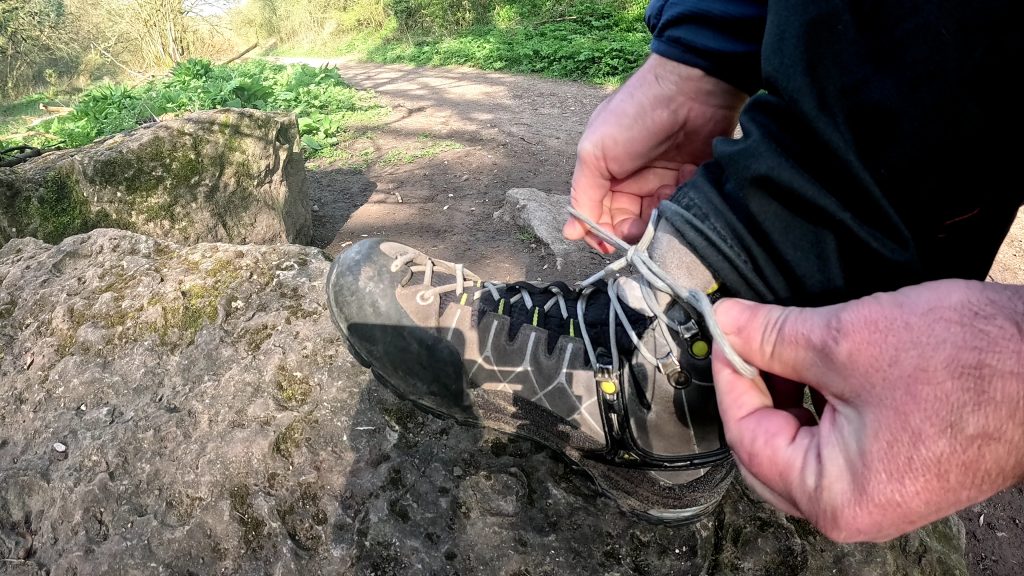
Scenario: A Blister in the Group
You’re halfway through a 12 km walk. The terrain is mixed — some stone slabs, some muddy sections, and a bit of ascent. One member of the group starts to fall behind, complaining of pain between the toes. The rest of the group is moving well and wants to keep up the pace.
This is where leadership matters.
Guidance for treating blisters: NHS – Blisters – NHS
1. What Equipment Do You Have?
A good leader’s footcare kit is small but powerful. Ideally you have:
- Compeed blister plasters (toe‑sized and heel‑sized)
- Zinc oxide tape (sticks even when damp)
- Micropore tape (gentler, good for layering)
- Small scissors
- Alcohol wipes (to clean the area before applying anything)
- A spare pair of thin socks
- A tiny tub of Vaseline (for friction hot‑spots)
This is a tiny kit, but it solves 90% of foot problems on the hill.
2. What If the Blister Is Between the Toes?
Inter‑digital blisters are awkward. They hurt more, they’re harder to tape, and they often come from:
- wet socks
- grit between toes
- boots that are too tight
- or toes rubbing together on descent
Options you have on the hill:
A. Clean → Dry → Separate → Protect
- Clean the area with an alcohol wipe
- Dry thoroughly
- Place a small piece of folded gauze or rolled tape between the toes to separate them
- Apply zinc oxide tape around the toe to hold the separation in place
- Add a thin sock if you have one
This reduces friction immediately.
B. Use a toe‑sized Compeed
If the blister is intact and not too deep, a small Compeed can work — but only if the skin is dry.
C. Drain it?
Some people do this – it is not advised by the NHS as exposing the blister which is protecting the underlying skin, can cause an infection. – Blisters – NHS
3. Managing the Group Who Want to Push On
This is the leadership challenge.
The group is strong, they’re enjoying the pace, and they’re frustrated by the slowdown. Meanwhile, the person with the blister is embarrassed, in pain, and worried about being “the problem”.
Your leadership priorities:
- Safety first — untreated blisters can become open wounds
- Morale second — both for the injured walker and the group
- Pace third — but still important
What you do:
A. Stop the group briefly
Frame it as a planned pause, not a “problem stop”.
“Let’s take two minutes here for a quick check‑in and water break.”
This normalises the stop and removes blame.
B. Give the group a micro‑task
While you treat the blister:
- Ask two people to check the map
- Ask someone to take a photo
- Ask someone to look at the next section of terrain
- Ask the faster walkers to scout 50m ahead and back
This keeps them engaged and avoids the “standing around waiting” frustration.
C. Reset expectations
Once treated:
“We’ll go steady for the next 10 minutes to let the foot settle, then reassess.”
This gives the group a clear plan and avoids resentment.
D. Position the injured walker
Put them second in line, not at the back.
This:
- sets the pace
- prevents them falling behind
- stops the group stretching out
- avoids the psychological pressure of being “the slow one”
4. Pre‑Walk Considerations to Prevent Blisters
Good leadership starts before the walk even begins.
A. Footwear briefing
Encourage:
- worn‑in boots
- correct sock choice
- toenails trimmed
- no brand‑new footwear (This can be common for new youth groups)
B. Pre‑emptive taping
If someone knows they blister easily:
- tape heels, toes, or arches before setting off
- apply Vaseline to high‑friction areas
- check lacing tension
C. Spare socks
A dry pair halfway through the walk can prevent 80% of toe blisters.
D. Group culture
Set the tone early:
“If you feel a hotspot, tell me immediately. We fix small problems before they become big ones.”
This prevents the “I didn’t want to slow everyone down” spiral.
5. Leadership Summary
A blister is never just a blister. It’s:
- a medical issue
- a morale issue – can create negative experience of the day
- a pacing issue
- a group‑dynamics issue
Handled well, it becomes a moment of calm, competent leadership that builds trust.
Handled poorly, it becomes frustration, resentment, and a miserable walk for one person.