
A — Accompaniment: – Risk groups
Mountain Rescue teams across England and Wales are seeing a clear pattern: incidents aren’t just about terrain or weather — they’re often about how people behave as a group. In the Peak District alone, volunteer teams responded to 632 incidents between January and December 2025 , making it one of the busiest mountain regions in the UK.
A striking trend has emerged. Men under 25 are now the highest‑risk group, with incident numbers rising sharply in recent years. Much of this increase is linked to the influence of social media, where dramatic photos and viral challenges encourage inexperienced walkers to push beyond their ability — often without the skills, kit, or awareness to stay safe. This mirrors national reporting that young hikers are increasingly being rescued after attempting risky routes inspired by influencers .
Why Accompaniment Matters
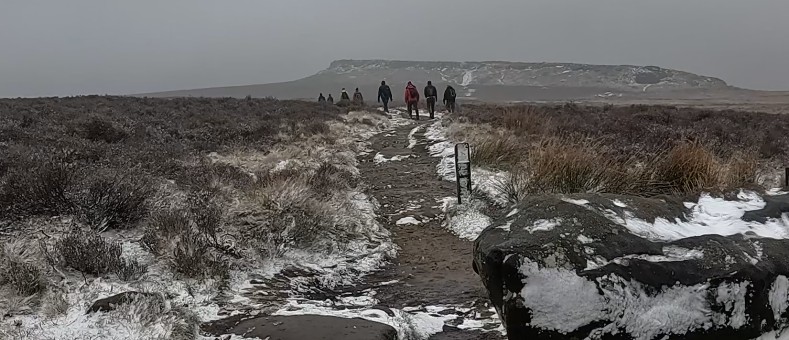
When people walk together, they make decisions together — and this is where things can go wrong. The 2025 national incident data shows that poor decision‑making and human error were the single biggest contributory factor, recorded in 939 incidents, with inexperience close behind at 644 . These aren’t dramatic mountaineering accidents; they’re everyday choices that can snowball into avoidable emergencies.
The most common reason for rescue remains simple: slips and trips — the primary cause of call‑outs across England and Wales . In the Peak District’s steep, rocky, and often muddy terrain, rushing, splitting the group, or following someone who is pushing too fast can quickly lead to injury.
The Accompaniment Message
Accompaniment is about group awareness:
- Stay together through tricky terrain.
- Match the pace to the least experienced walker.
- Talk openly about confidence, fatigue, and route choices.
- Slow down on wet rock, loose stone, and steep descents.
- Encourage good footwear and realistic expectations.
- Challenge “social media bravado” when it appears.
Walking well as a strong group is one of the protections against becoming a statistic — and one of the simplest ways to ensure you never need to call out the Mountain Rescue Team.
A Note for Peaks Compass Visitors
If you follow the PEAKS acronym — especially considering Accompaniment — you dramatically reduce the chance of needing help. The outdoors is safest when we move thoughtfully, communicate clearly, and support each other’s decisions. The Peak District is a beautiful place to explore, but it rewards those who prepare, pace themselves, and stay grounded in reality rather than online influence.

Other Risk Groups in the Mountains
While men under 25 now represent the highest‑risk group, the wider national data shows that incidents affect a broad range of people — often for very different reasons.
Age‑Related Patterns
The 2025 incident data shows a clear curve:
- Young adults (18–24) are the most likely to need help, often linked to overconfidence, social media influence, and limited experience.
- Middle‑aged walkers (40–60) appear frequently in call‑outs too, often due to slips, fatigue, or medical issues emerging during longer days out.
- Older walkers (65+) feature in smaller numbers but with proportionally higher medical‑related rescues, especially cardiac events and mobility‑related injuries.
Gender
Across England and Wales, 60% of rescued individuals are male. This doesn’t imply men are “less safe” — it reflects participation rates, risk appetite, and the influence of online challenges that may disproportionately target young male audiences.
Experience Levels
Two of the biggest contributory factors nationally are:
- Poor decision‑making / human error — 939 incidents
- Inexperience — 644 incidents
Both appear consistently across all age groups. This reinforces the Accompaniment message: groups must communicate honestly about ability, confidence, and route choices.
Terrain‑Specific Risks
The Peak District’s 632 incidents in 2025 were dominated by:
- Slip‑trip injuries (the number one reason for rescue nationally)
- Steep, rocky descents around Kinder, Mam Tor, and the Great Ridge
- Wet, polished gritstone and loose shale paths
- Sudden weather changes on high plateaus
These risks affect everyone, regardless of age or experience — especially when groups split up or rush.
References
- MREW Annual Review 2026 — UK incident statistics, contributory factors, and national slip‑trip data.
- MREW: Young Hikers Rescued After Social Media Boom — rise in under‑25 incidents and behavioural trends.
- Peak District Incident Totals (2025) — regional call‑out numbers across local MRT teams.
- UK Mountain Rescue Statistics — national overview showing slips and trips as the leading cause of rescue.